How Often Are Bakery Products Recalled for Foreign Material?
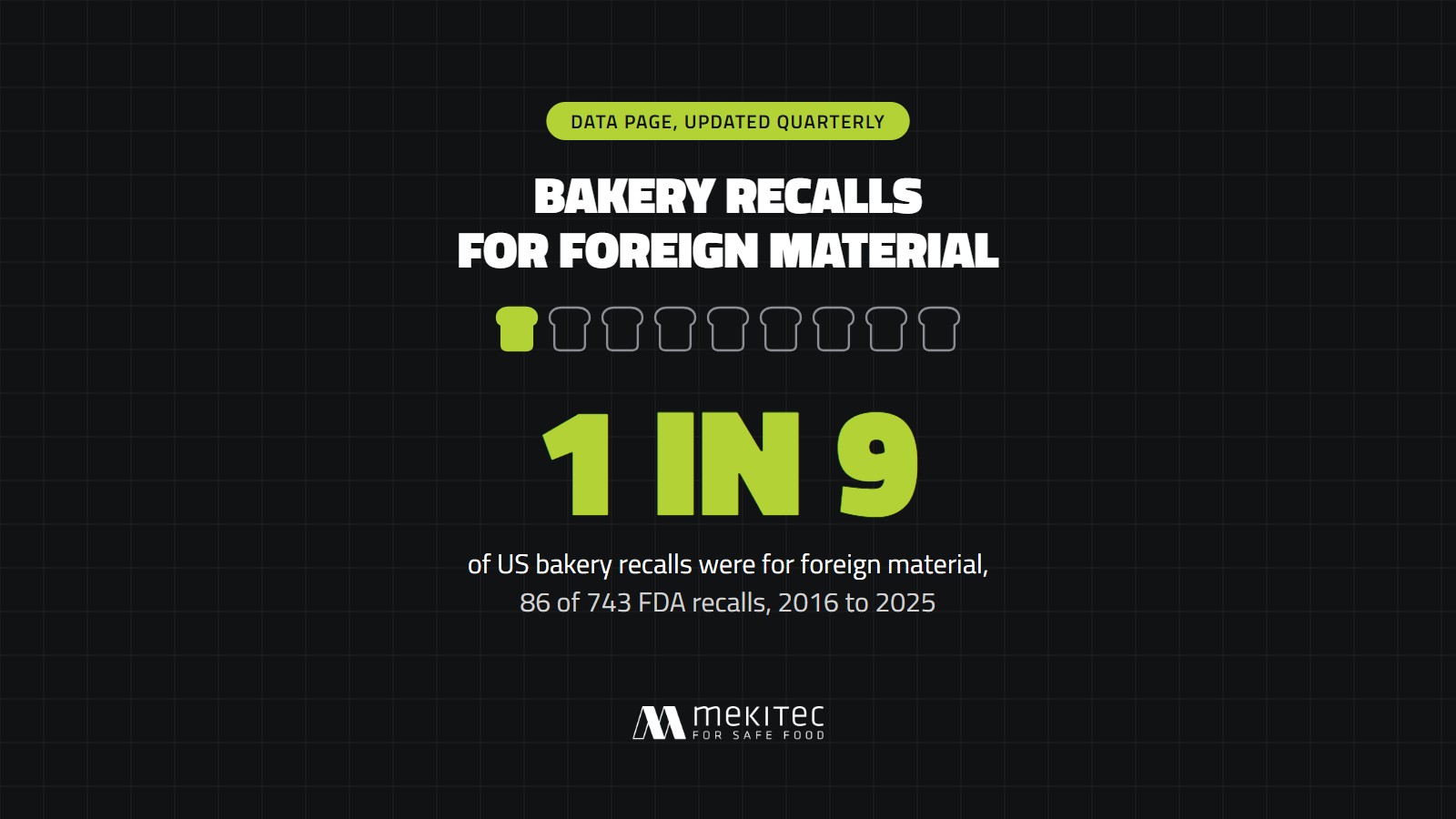
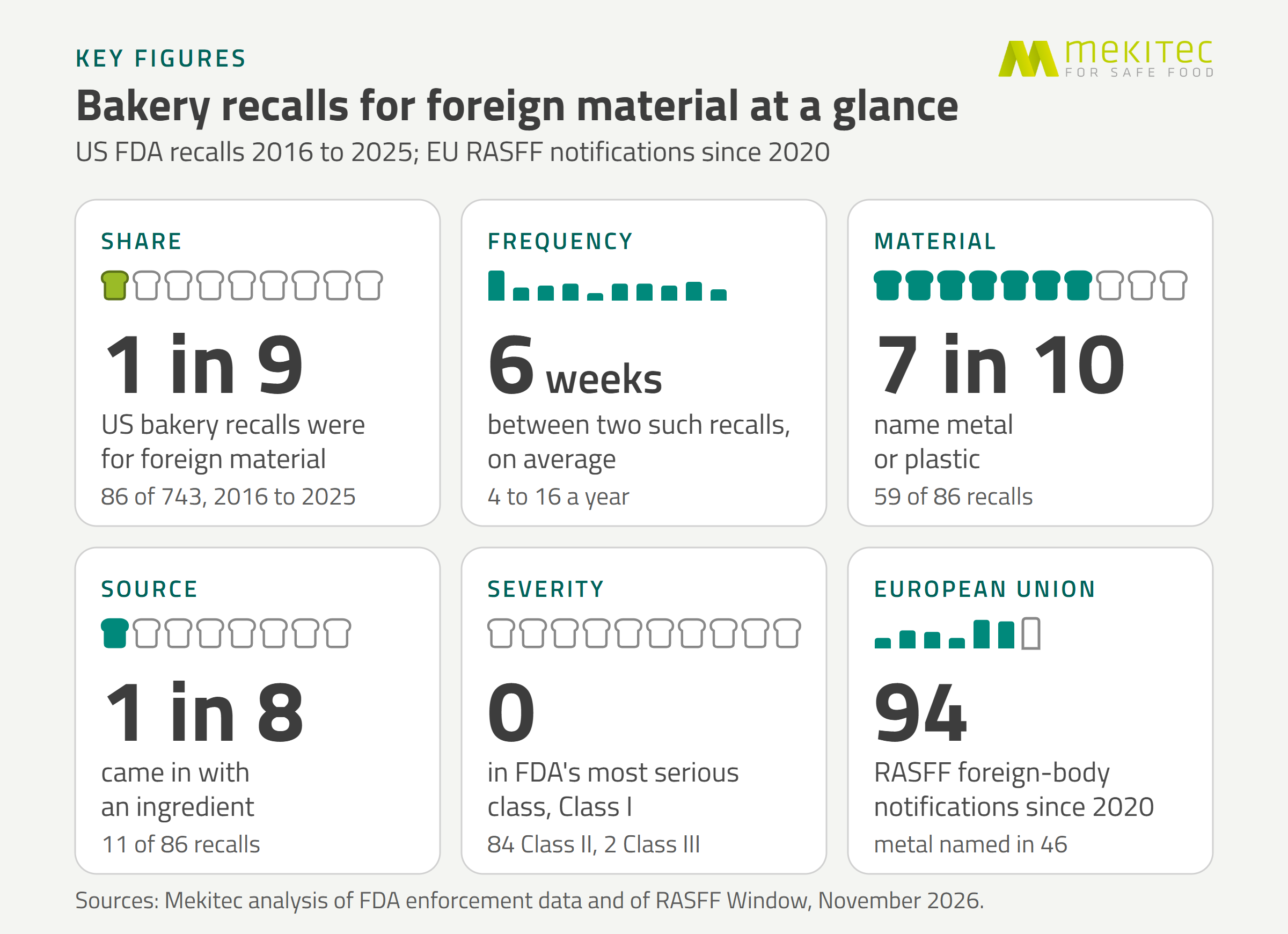
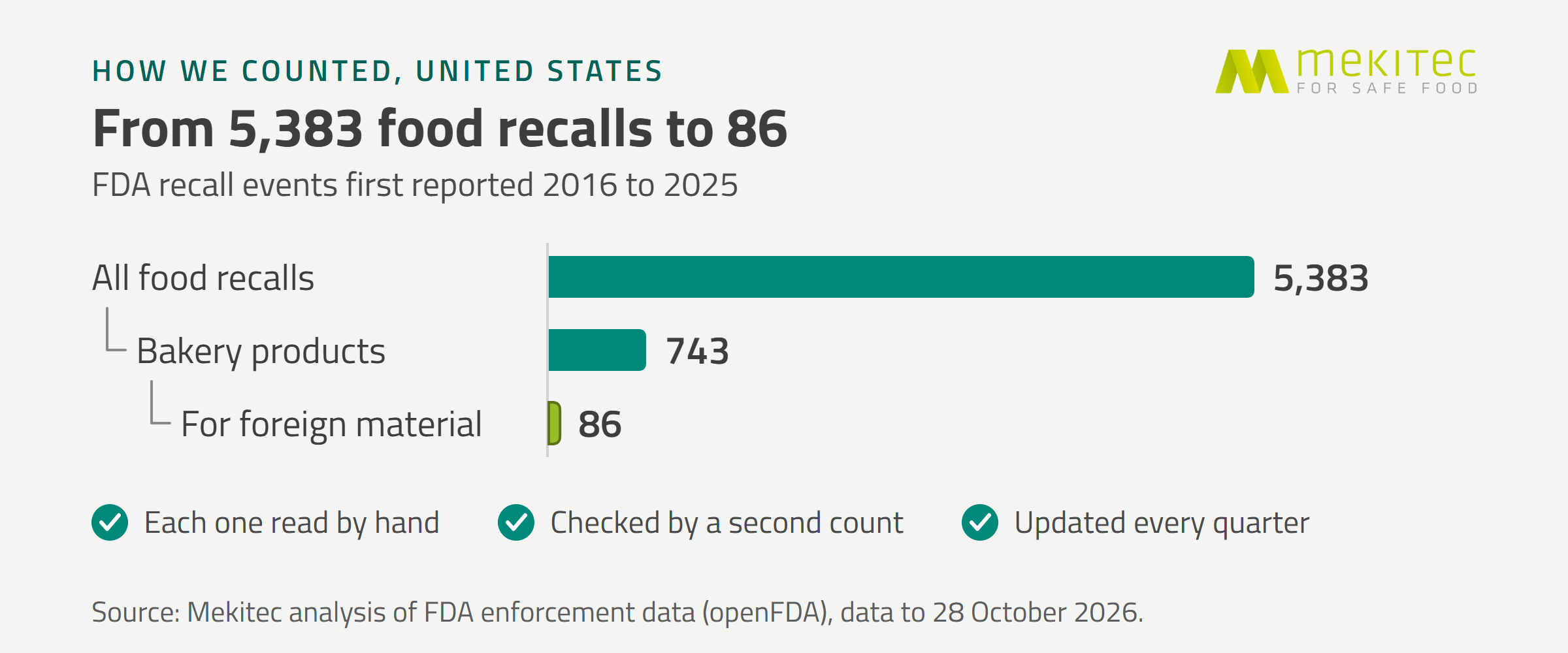
FDA Enforcement Reports list 86 recalls of bakery products for foreign material in the United States between 2016 and 2025: about one every six weeks on average, and about 1 in 9 of all bakery recalls. Metal or plastic is named in about 7 of 10 of them. The EU's RASFF alert system recorded 94 foreign-body notifications on bakery products from January 2020 to 9 November 2026, 74 of them in the full years 2020 to 2025, with metal named in about half. These are Mekitec's own counts of public regulator data, updated every quarter.
US data to 28 October 2026. EU data to 9 November 2026. Next update: February 2027.
Key figures
Six numbers sum up ten years of US recalls and the EU alerts since 2020.
US recalls for foreign material, by year
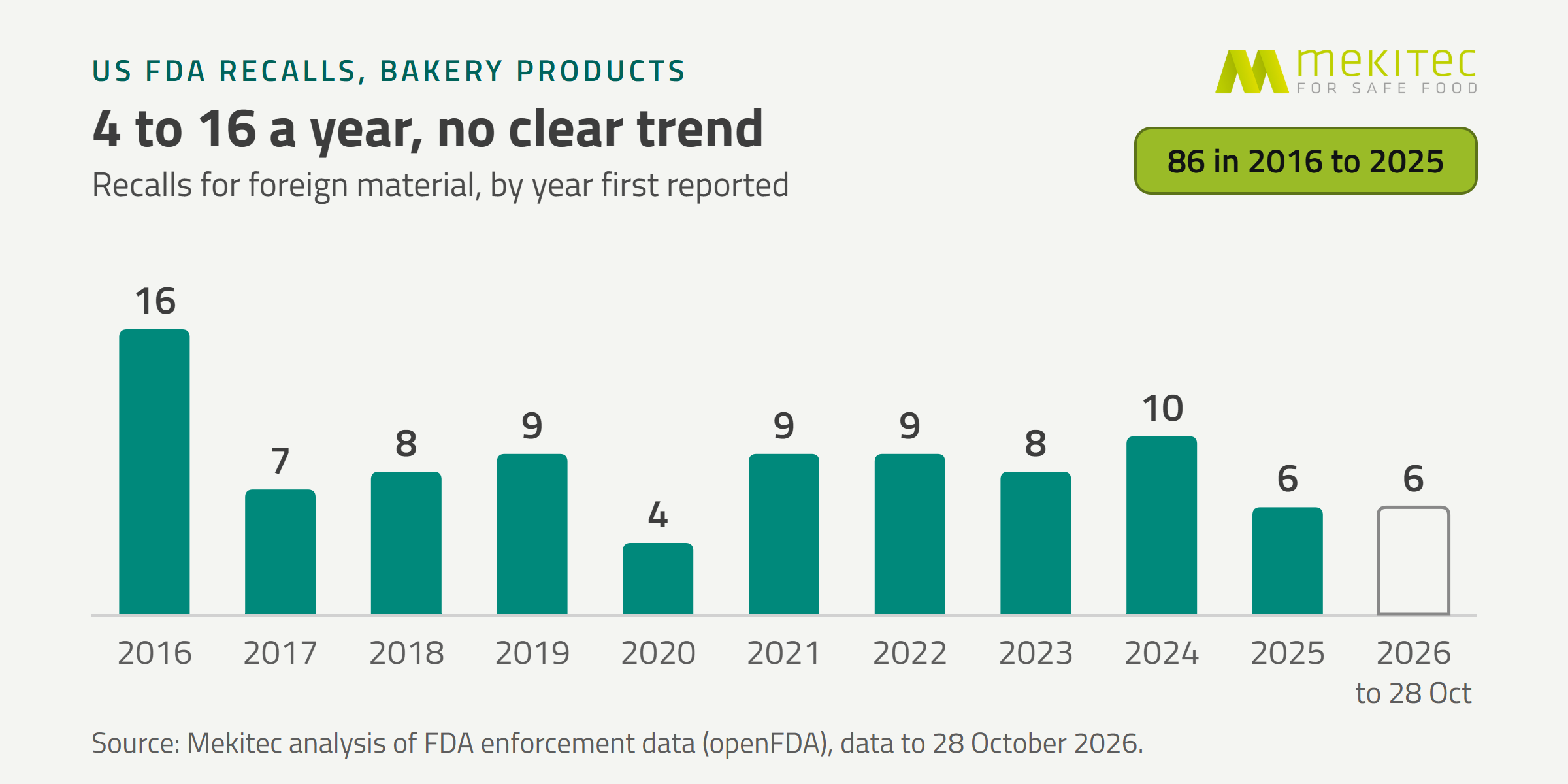
From 2016 to 2025, FDA Enforcement Reports listed between 4 and 16 bakery recalls for foreign material a year, eight or nine in a typical year, with no clear trend. The 2026 column runs only to 28 October, so it is not a full year.
Which foreign materials were named
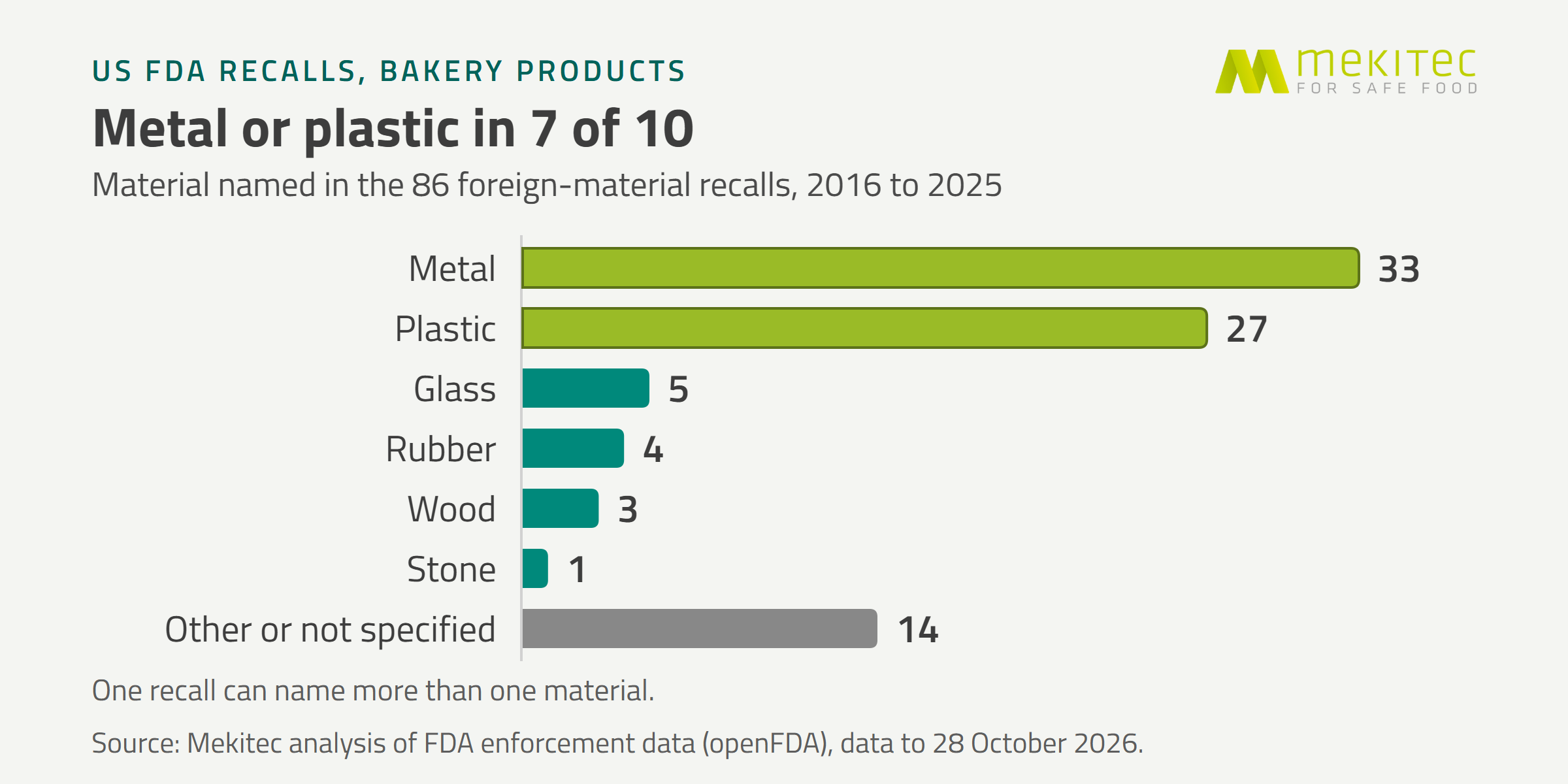
Metal is named in 33 of the 86 recalls and plastic in 27; one names both, so 59 (69%) name metal or plastic. The other 14 name none of these materials: 12 say only foreign object or foreign material, one names possible corn husk and one a white and blue strand.
How serious were these recalls?
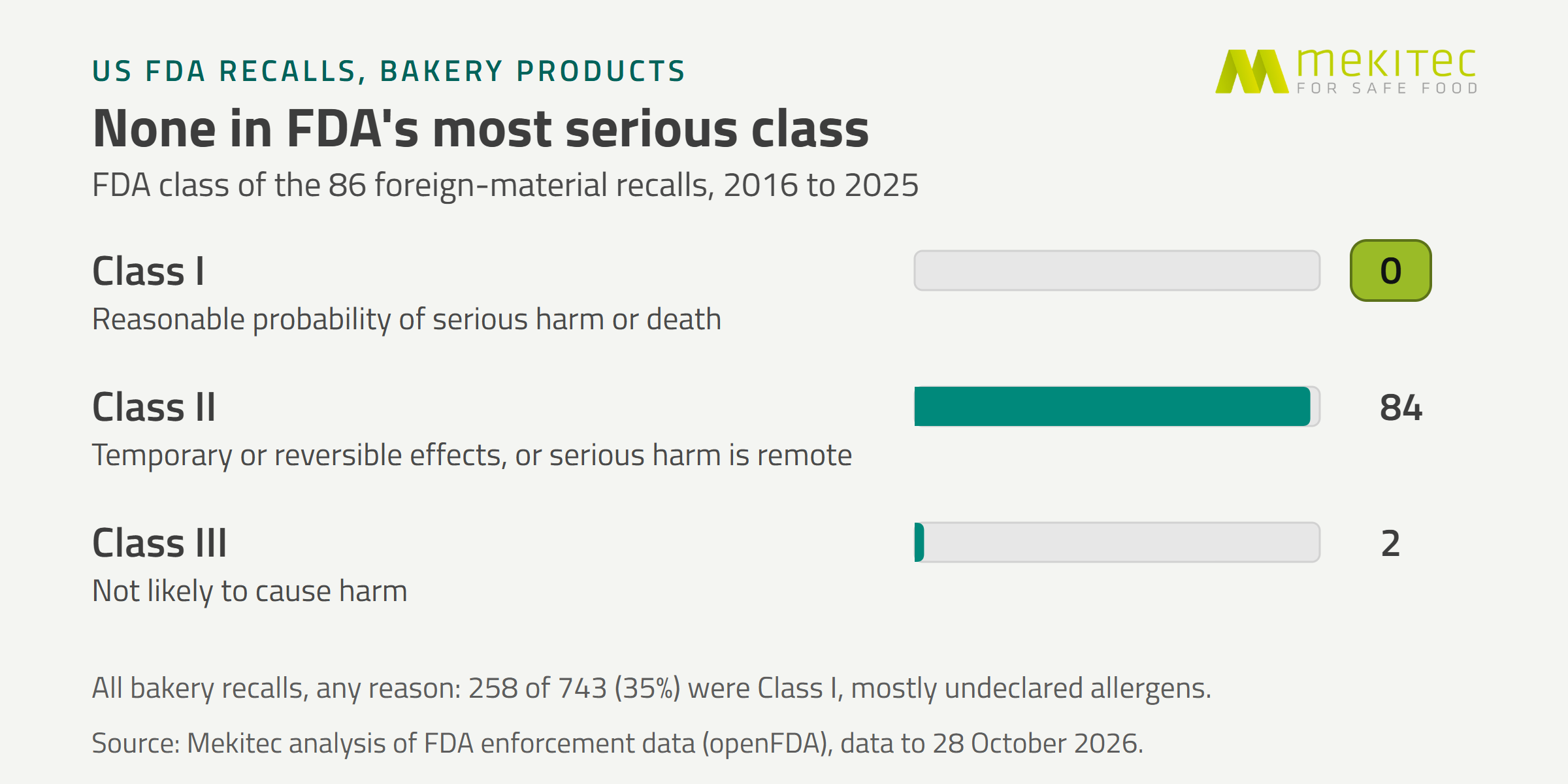
None of the 86 was Class I: 84 were Class II and 2 were Class III (FDA recall definitions). Even one fragment matters to the regulator: FDA's Compliance Policy Guide considers a ready-to-eat food, or one that needs only minimal preparation, adulterated if it contains a hard or sharp foreign object 7 to 25 mm long, and smaller objects can count where infants, surgery patients or the elderly eat the food (CPG Sec. 555.425).
Where the contaminant came from
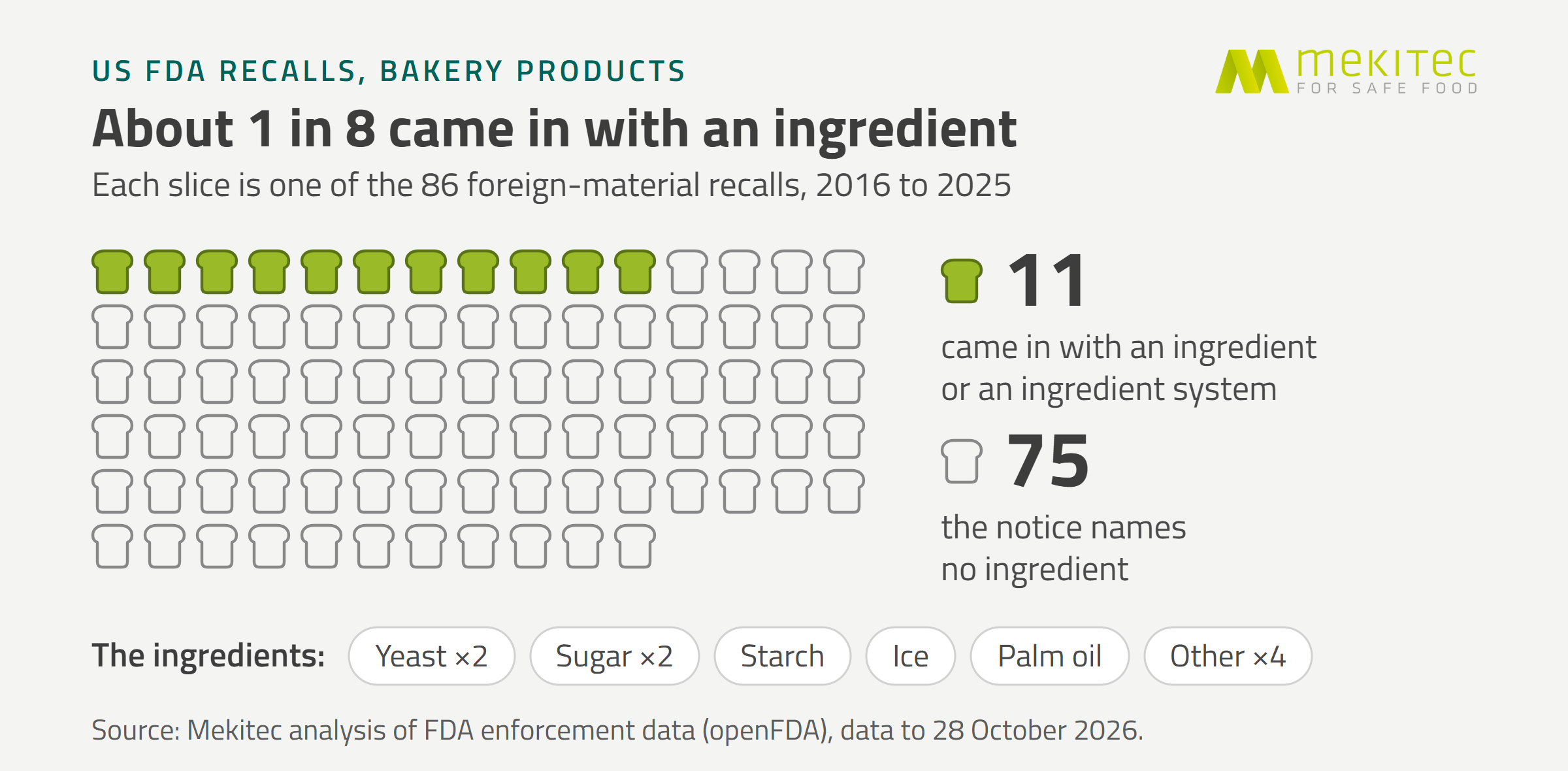
In 11 of the 86 recalls, about 1 in 8, the notice traces the material to an ingredient, including two cases in the bakery's own ingredient handling, a palm-oil silo and a sugar system. So incoming ingredients and their handling belong in the hazard analysis as much as the line itself.
What a bakery can do about it, and what X-ray can and cannot find in bread: What Gets Into Bread, and What X-ray Can Catch.
EU RASFF notifications
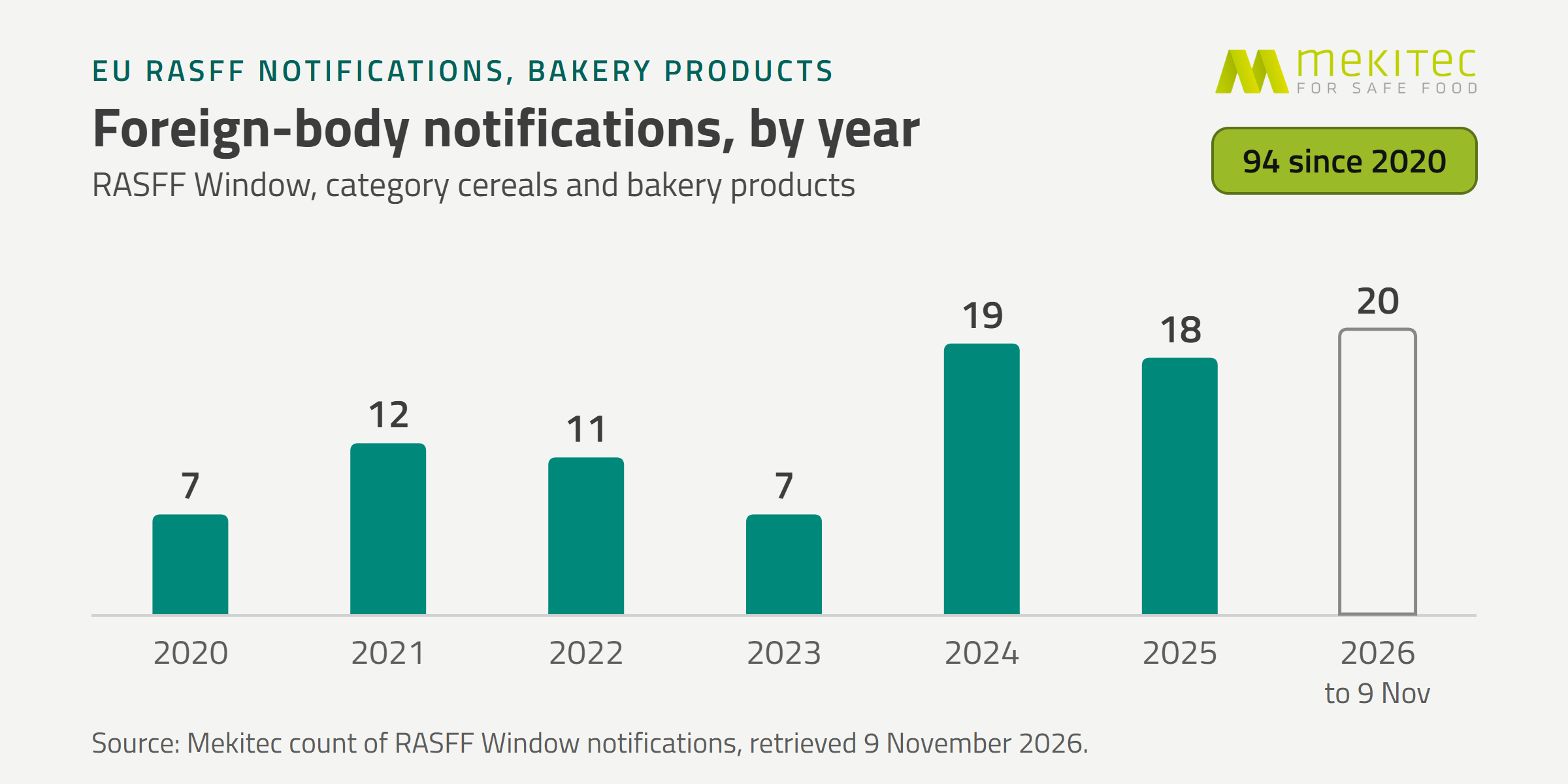
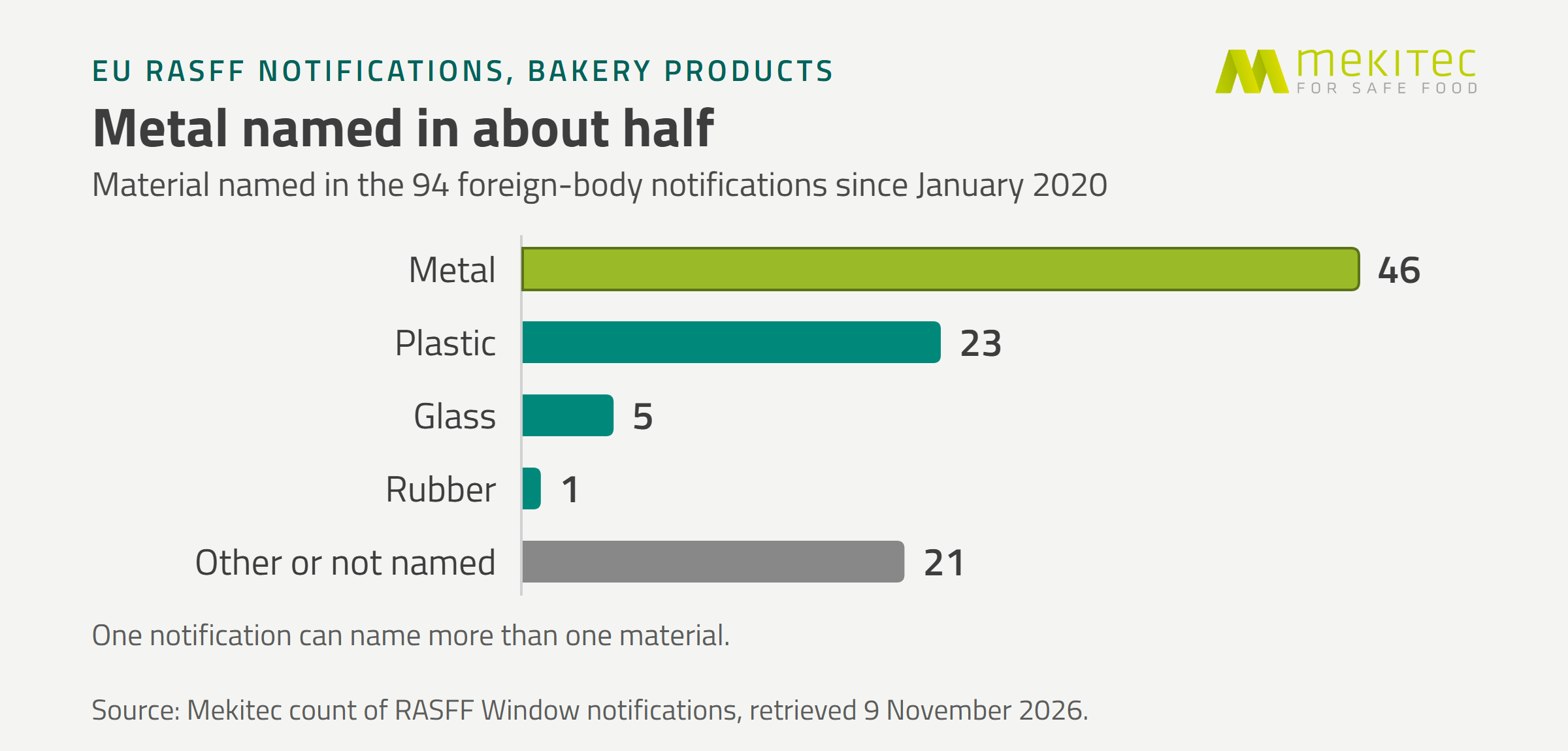
The EU's Rapid Alert System for Food and Feed (RASFF) lists 94 foreign-body notifications on bakery products from January 2020 to 9 November 2026, and 63 of them were rated serious. The products came from 22 countries, inside and outside the EU. The count roughly doubled from 2024; RASFF counts notifications, so this alone does not show whether incidents became more frequent.
In both the US and the EU data, metal is the material named most often, followed by plastic and then glass.
The European Commission's Alert and Cooperation Network (ACN), which covers food-safety alerts as well as non-compliance and fraud cases, gives the wider picture: it logged 562 notifications on cereals and bakery products in 2024 and 487 in 2025, and foreign bodies were 7% of the issues reported in that category in both years; the category also includes rice and flour (ACN annual report 2024, ACN annual report 2025). The US and EU counts are not directly comparable: RASFF records notifications exchanged between national authorities, not every recall in every country.
How this compares with other published counts
Other counts use different units, periods and product scopes, so compare figures only within one source.
- Events or product records: this page counts recall events. A 2026 study in the journal Foods counted 24,761 FDA product recall records from 6,674 recall events in fiscal years 2013 to 2025, about 3.7 products per event, and found physical hazards in 8.3% of the records. Its authors note that a share computed on records is not interchangeable with one computed on events (Zhang, Wong and Schaneberg, 2 September 2026).
- All foods in the US: a 2026 study in PLOS ONE attributes 7.6% of 26,877 FDA food recalls from 2012 to 2024 to foreign material, and lists dairy and bakery products among the categories where it was observed most often (Chen et al., 19 August 2026). Its totals, about 2,000 a year, are on the scale of FDA's product records; counted by recall event, as on this page, the share for all foods in 2016 to 2025 is 10.1%.
- United Kingdom: the trade magazine British Baker counted 113 bakery recalls on the Food Standards Agency website from 2021 to 2025. Foreign bodies were the second most common reason after undeclared allergens, and metal accounted for 57% of the foreign-body recalls, plastic for 23.8% and glass for 9.5%. Its count also includes sandwiches, wraps and sausage rolls, which this page leaves out (British Baker, 4 February 2026).
This page adds what they do not have: bakery counts for the US, by recall event with the material and the ingredient origin, and for the EU, by RASFF notification with the material.
How we counted
United States
- Source: the openFDA food enforcement API, which publishes the FDA Enforcement Reports: every record first reported from 6 January 2016 to 28 October 2026.
- Unit: a recall event (FDA event ID), dated by the year it first appeared in an FDA Enforcement Report. One event can cover several products; an event whose products fall into two FDA classes is counted under the more serious class.
- Bakery product: bread, buns, rolls, bagels, tortillas, muffins, cakes, cookies, biscuits, croissants, pastries, doughnuts, pies, brownies, waffles, flatbreads and similar products, plus baking mixes and raw doughs. Not crackers, pretzels, pizza, sandwiches, meal kits, flours and other ingredients, ice cream or pet food. Seven of the 86 are borderline cases kept in the count: bakery mixes and bases, some sold in bulk, bread crumbs, a croissant sandwich recalled for metal in the croissant, and a cheese snack in a battered tortilla.
- Foreign material: the recall reason names foreign or extraneous material, metal, plastic, glass, rubber, wood, stone or wire. Not heavy metals, packaging that is only mentioned, or allergens described as foreign material.
- Reasons: recall reasons were grouped by keywords into undeclared allergens and labelling, microbial hazards and foreign material; one recall can fall into more than one group.
- Checks: each of the 86 was read by hand. A second count, written independently, found six recalls the first word list had missed; with the corrected list, both give the same 86. Other reasonable definitions give a share between 10.8% and 12.9%.
- Limits: FDA-regulated foods only, so most bakery items with meat, which USDA regulates, are not included. Keyword matching misses a reason that names only, for example, cloth; two such bakery recalls from 2016 are known and not counted. openFDA states that its data are not validated; the FDA Enforcement Report is the official record.
European Union
- Source: the RASFF Window public search, product category "cereals and bakery products", every notification validated from 1 January 2020, retrieved on 9 November 2026. RASFF also covers Iceland, Liechtenstein, Norway and Switzerland; four of the 94 were notified by Switzerland or Iceland.
- Bakery foreign body: the notification subject names a foreign body or a physical contaminant, in English, Italian, Spanish, German, French, Dutch or Polish, and a bakery product, with the same product scope as the US count. Every subject was read by hand.
- Limits: subjects only, and some biscuits and cakes are filed under confectionery and are not included, so the count is a minimum. The year is the date the European Commission validated the notification.
Data
- US: yearly figures from 2016 to 28 October 2026, and the list of the 92 recall events in that period, 86 of them in 2016 to 2025, with their FDA identifiers.
- EU: the list of the 94 RASFF notifications with their reference numbers.
- Both lists are available as CSV files on request through the contact page.
- Next update: February 2027.
The figures as text
- US recalls by year: 2016: 16; 2017: 7; 2018: 8; 2019: 9; 2020: 4; 2021: 9; 2022: 9; 2023: 8; 2024: 10; 2025: 6; 2026 to 28 October: 6.
- US materials, of 86 recalls: metal 33, plastic 27, glass 5, rubber 4, wood 3, stone 1, other or not specified 14.
- US FDA class, of 86 recalls: Class I 0, Class II 84, Class III 2.
- EU notifications by year: 2020: 7; 2021: 12; 2022: 11; 2023: 7; 2024: 19; 2025: 18; 2026 to 9 November: 20.
- EU materials, of 94 notifications: metal 46, plastic 23, glass 5, rubber 1, other or not named 21.
Questions about the data
How often are bakery products recalled for foreign material in the US?
About one every six weeks on average. FDA Enforcement Reports list 86 bakery recalls for foreign material between 2016 and 2025, between 4 and 16 a year, according to Mekitec's analysis of FDA enforcement data.
What share of bakery recalls is caused by foreign material?
About 1 in 9. Foreign material was the reason for 86 of the 743 US bakery recall events from 2016 to 2025 (11.6%), according to Mekitec's analysis of FDA enforcement data.
What foreign material is found most often in bakery recalls?
Metal and plastic. Metal was named in 33 of the 86 US bakery recalls for foreign material from 2016 to 2025 and plastic in 27; at least one of the two appears in 59 of them (69%), according to Mekitec's analysis of FDA enforcement data.
What are the most common reasons for a bakery recall?
In the US, undeclared allergens and labelling errors: they were behind 517 of the 743 bakery recalls from 2016 to 2025 (70%). Microbial hazards follow with 118 (16%), and foreign material is third with 86 (11.6%), according to Mekitec's analysis of FDA enforcement data. One recall can have more than one reason.
Are bakery products more likely than other foods to be recalled for foreign material?
Not clearly. Foreign material was behind 11.6% of US bakery recall events from 2016 to 2025 (86 of 743) and 9.8% of all other FDA food recall events (457 of 4,640), a gap small enough to be chance. Bakery products account for 13.8% of all the events and for 15.8% of the foreign-material ones. What stands out is the steady rate, not the difference.
Were any of these recalls in FDA's most serious class?
No. FDA rated all 86 bakery recalls for foreign material from 2016 to 2025 as Class II or Class III. In the same period 258 of all 743 bakery recalls (35%) were Class I, most of them for undeclared allergens.
Does the EU have comparable data?
Not directly. The EU's RASFF system lists 94 foreign-body notifications on bakery products from January 2020 to 9 November 2026 (74 in the full years 2020 to 2025), with metal named in 46. Notifications and recalls are different measures, so the US and EU figures should not be added together or compared directly.
Why do other sources give different percentages?
Because they count different things. This page counts recall events, while several studies count product records, and one event covers several products (3.7 on average in a 2026 study of FDA data). Periods, product scope and the definition of foreign material differ too, so compare figures only within one source.
How often is this page updated?
Every quarter. The next update is planned for February 2027.
Published by Mekitec, which develops and manufactures X-ray inspection systems and software for food producers worldwide, with more than 2,000 MEKI systems delivered in over 45 countries. For what a bakery can do about foreign material, read What Gets Into Bread, and What X-ray Can Catch.
Cite as: Mekitec, Bakery foreign-material recall data (US FDA data to 28 October 2026, EU RASFF data to 9 November 2026). The charts may be republished unchanged, with this credit and a link to this page, and the figures quoted with the same credit.